


Flatweave Rugs — Kilim, Dhurrie & Panja, Woven in India's Carpet Belt
Flatweave is the oldest way humans have made rugs — and the core of what we manufacture at Pihue Creations. From our looms in the Bhadohi–Mirzapur belt, we produce kilims, dhurries and panja flatweaves for retailers, designers and hotels worldwide: reversible, durable, quick to produce, and endlessly customizable. This page is our complete reference on the craft — what flatweave is, how the traditions differ, and how to source it well.
What Is a Flatweave Rug?
A flatweave rug has no pile. Instead of knots tied onto a foundation and clipped (as in hand-knotted carpets), the pattern is created by weaving weft yarns tightly through warp threads — the design IS the structure. The result is a thin, flexible, flat textile that is:
-
Reversible — most flatweaves are identical or near-identical on both faces, doubling their usable life
-
Durable — with no pile to crush, flatweaves handle high traffic, which is why hotels and busy homes specify them
-
Lighter and faster to produce — typically 35–45 days sampling-plus-production at our looms, the fastest construction we offer
-
Naturally suited to layering — the flat profile sits cleanly under furniture and over larger rugs

Kilim vs. Dhurrie — What's Actually the Difference?
The two words are often used interchangeably; the distinction is real but simple:
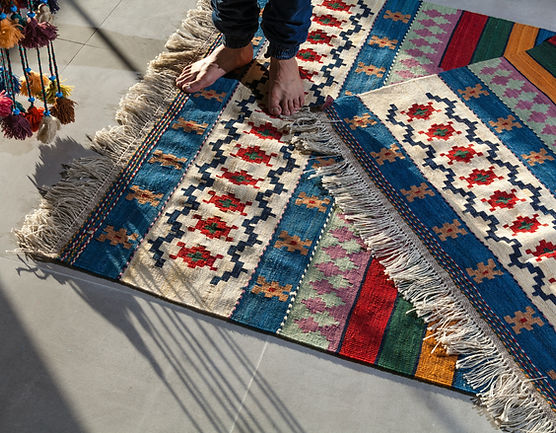
Kilim is the Anatolian/Persian-lineage tradition — tapestry (slit-weave) technique, classically wool on wool, known for bold geometric motifs and the small slits that form where colors meet. The vocabulary of kilim design — diamonds, medallions, latch-hooks — travelled the old trade routes into India.
Dhurrie (also dari/durrie) is India's own flatweave, woven here for centuries for homes, courts and temples. Traditionally cotton on cotton — which allows crisp lines, pastel and vivid dyes, and easy washing — though today we weave dhurries in wool, jute and blends as well. Dhurries are typically interlocked rather than slit-woven, giving a smooth, gap-free surface.
In practice at our looms: the technique families overlap, and most modern "kilim-style" rugs sold globally are woven exactly as dhurries are. What matters to a buyer is material, weight and design language — all of which we customize.

Panja Weaving — The Mirzapur Signature
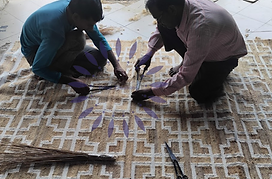
The panja is the weaver's tool that defines this region's flatweave: a metal claw (panja means "claw" in Hindi) used to beat each weft thread firmly down into place on a vertical or horizontal loom. Panja weaving produces a dense, tight, hard-wearing flatweave — and the Mirzapur handmade dari carries India's Geographical Indication (GI) registration, the government's certification that this craft belongs to this soil.
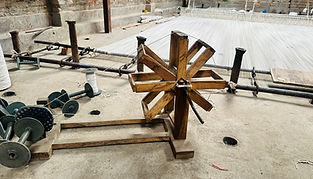
Our workshops sit inside this GI heartland. The weavers who make Pihue flatweaves learned panja technique the way it has always been passed on — hand to hand, family to family — and we pair that inheritance with modern production discipline: CAD-first design, dye-lot control, and per-piece quality checks.
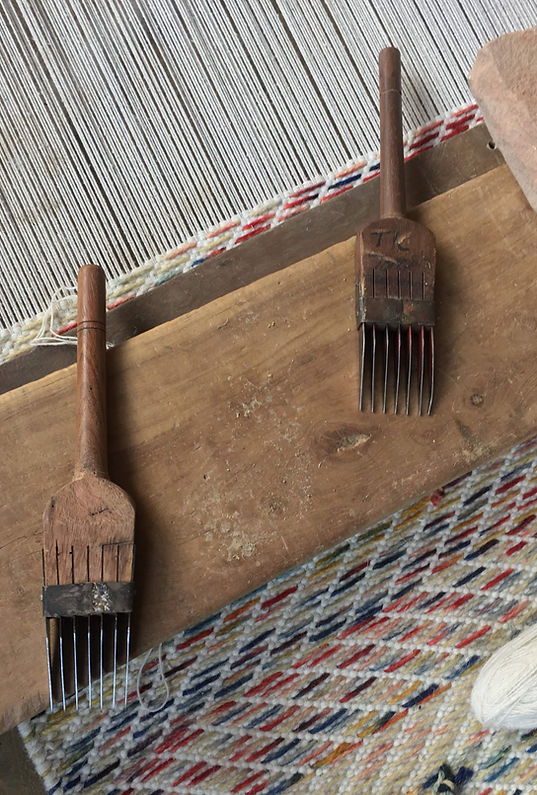


The panja: the claw tool that gives Mirzapur's GI-registered flatweave its name and density
Materials We Weave Flat — the Full Fibre Range
Flatweave is the most material-versatile construction in rug making — the technique accepts nearly any spinnable fibre. At Pihue we weave flat in:
Wool — the premium flatweave fibre: springy, insulating, naturally stain-hiding and flame-resistant. We weave in wools from New Zealand, Himalayan, Indian and other origins.
Cotton — the classic dhurrie yarn: crisp pattern definition, soft underfoot, washable, budget-friendly.
Jute — earthy texture and golden tone; the workhorse of natural-fibre flooring, strong and economical.
Sisal — from the agave plant: the stiffest, hardest-wearing natural fibre; ideal for high-traffic natural looks.
Abaca — banana-plant fibre from the strongest natural fibre family; silky lustre with remarkable durability.
Hemp — antimicrobial by nature, softens with use, exceptionally strong.
Linen (flax) — cool-touch, elegant drape, refined sheen; the quiet-luxury natural.
Silk & bamboo silk — for flatweaves with lustre: fine detail and sheen in a flat profile.
PET yarn (GRS-certified recycled) — spun from recycled plastic bottles: fade-resistant, mould-proof, hoseable — the true indoor-outdoor flatweave fibre. Ours carries Global Recycled Standard certification with chain-of-custody documentation.
Fibres can be blended in one weave — wool-cotton, jute-wool, jute-chenille — to hit any hand, weight and price point.


Where Flatweaves Work Best
High-traffic homes and rentals · hotel corridors and guest rooms (contract programs on install-date schedules) · dining rooms (chairs slide cleanly on flat pile) · layering bases under smaller statement rugs · outdoor-adjacent spaces in PET blends · anywhere a client wants pattern without pile height.
Sustainability & Outdoor Performance — an Honest Guide
Custom Flatweave Manufacturing
Why flatweave is the sustainable construction: it uses meaningfully less fibre than pile rugs of the same size (no pile mass), is woven on hand looms with near-zero energy input, and reversibility doubles its service life. A natural-fibre flatweave — wool, jute, sisal, hemp, cotton, linen, abaca — is renewable at the field and biodegradable at end of life. Our GRS-certified PET flatweaves close the loop from the other direction: recycled bottles into decade-lasting floors.
Weather resistance — the truth by fibre: PET flatweaves are genuinely weatherproof — UV-stable, mould- and mildew-proof, rinseable; specify them for terraces, poolside, and covered outdoor areas. Wool resists moisture naturally and suits covered verandas. Jute, sisal, cotton and linen are best kept to dry indoor spaces — natural cellulose fibres absorb humidity, which is part of their character. Matching the fibre to the space is the sourcing skill; tell us the room and we'll spec the yarn.
This is our core capability: minimum order one rug, any size including runners of any length and irregular shapes, Pantone-matched dyeing with pom approval, your design or ours. From a designer's single bespoke dhurrie to full private-label flatweave collections under your brand — GoodWeave-audited looms, audit-ready certification documentation (RWS wool, Oeko-Tex, GRS, ISO 9001:2015, SMETA), export handled in-house from Bhadohi.
Lead times: flatweave is our fastest construction — indicatively 35–45 days sampling plus production, planned backward from your launch or install date.
Caring for a Flatweave
Vacuum without beater bar; rotate seasonally; flip it — reversibility is the built-in second life; blot spills immediately (cotton dhurries in solid colors can often be professionally washed); use a thin rug pad to prevent creeping on hard floors.