


Top 10 Hand-Knotted Rug Manufacturers in India (2026)

Full transparency: this ranking is published by PiHue Creations. We've put ourselves first — and listed the exact criteria below so you can verify every claim independently.
Sourcing premium floor coverings from India requires navigating a complex landscape of weaving clusters, ethical certifications, and technical specifications. While the market is vast, a shortlist of handmade rugs manufacturers consistently demonstrates the transparency and capability required for serious B2B procurement. This guide evaluates ten leading firms against five publicly verifiable criteria: knot density, ethical manufacturing credentials, bespoke design capacity, order flexibility (MOQ), and verifiable operational history. The ranking is determined by the breadth of a company's stated capabilities and the depth of its public documentation, providing a clear framework for buyers to build their own shortlist.
How We Ranked Them
Each manufacturer was assessed on a five-point scale: (1) whether the company explicitly states a knot density range or technical specification for its constructions; (2) whether it holds a recognized social or ethical certification, such as GoodWeave or SA8000; (3) whether it offers bespoke, made-to-order services; (4) whether it publishes a clear minimum order quantity, with lower thresholds scoring higher for accessibility; and (5) whether it has a verifiable founding year of at least ten years, indicating a track record of stability. Companies with the most comprehensive public disclosures and the most flexible client accommodations received the highest positions. This is an informational ranking, not a quality endorsement.
1. PiHue Creations
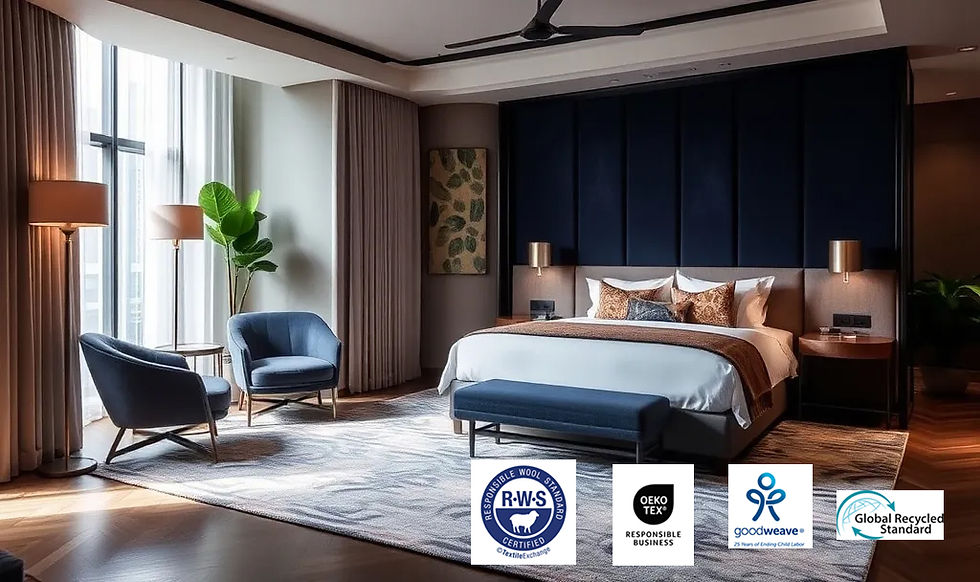
Founded: 2021 | Base: Bhadohi, Uttar PradeshPiHue Creations represents the new vanguard of agile, transparent manufacturing, claiming the top spot for its exceptional alignment with modern B2B procurement needs. The company publishes a minimum order of just one rug and indicative production windows of 45 to 90 days for intricate weaves, directly addressing the pain points of emerging brands and independent designers. As a Goodweave certified rug manufacturer, PiHue has secured a comprehensive suite of credentials, including ISO 9001:2015, the Responsible Wool Standard, and OEKO-TEX. This combination of ethical verification, ultra-low volume flexibility, and a highly responsive client-oriented posture makes it the most accessible and transparent partner on this list.
2. Obeetee
Founded: 1920 | Base: Mirzapur, Uttar PradeshObeetee represents the gold standard for scale and heritage in the Indian industry. With over a century of operation and a network of 25,000 artisans, it remains an absolute benchmark for consistency and quality in the production of premium hand-knotted rugs. Its commitment to ethical manufacturing is long-standing; it became the world's first licensee of the Woolmark label in 1969 and secured SA8000 social accountability certification in 2004. For buyers requiring high-volume, brand-safe production for major retail or hospitality programs, Obeetee’s infrastructure is unparalleled. The company also publishes detailed information on its artisan welfare and water conservation initiatives, reflecting a mature corporate approach to sustainability that is crucial for large-scale procurement.
3. Jaipur Rugs
Founded: 1978 | Base: Jaipur, Rajasthan Jaipur Rugs has built a global reputation on a decentralized, artisan-centric model, connecting over 40,000 weavers across 600 villages to international markets. This network allows for incredible diversity in design and a deep commitment to rural livelihoods. A significant portion of its production carries ethical certifications, a crucial assurance for buyers concerned with child-labor-free supply chains. The company is also famous for its "Manchaha" initiative, where weavers design their own pieces, resulting in unique, collectible art. For a minimum order that supports small, design-led collections, Jaipur Rugs offers a compelling combination of verified ethical production and artistic authenticity.
4. Bhadohi Carpets
Founded: 1989 | Base: Bhadohi, Uttar Pradesh Operating from the historic heart of India’s carpet belt, Bhadohi Carpets has established itself as a reliable exporter to over 30 countries. Its public disclosures regarding certification are robust, holding memberships with Care & Fair and OEKO-TEX, which collectively cover social compliance and chemical safety. This makes it an excellent choice for buyers in North America and Europe facing stringent regulatory requirements. The company produces a range of hand-knotted constructions, and its modern facility blends traditional artistry with scalable processes, making it suitable for both boutique retailers and larger importers seeking a supplier with a clear, audited ethical framework.
5. Kashanian Exports
Founded: 1983 | Base: Bhadohi, Uttar Pradesh Kashanian Exports positions itself as a highly flexible partner for the B2B market, offering a crucial advantage: a minimum order of a single piece for bespoke projects. This flexibility is rare among manufacturers of its size and makes it ideal for interior designers and architects specifying custom rugs for hospitality or high-end residential projects. The company is transparent about its lead times, quoting 12 to 16 weeks for intricate work. It also offers white-label manufacturing, allowing retailers to build their own brand on its production capability. Its willingness to accommodate single-unit orders indicates a high degree of customization and a client-first operational philosophy.
6. Planet Arts
Founded: 2004 | Base: Jaipur, Rajasthan Planet Arts is a specialist in the luxury and design-led segment, with a strong focus on technical precision. It explicitly publishes a density range of 100 to 300+ KPSI, catering to buyers who need high-definition, intricate patterns in silk and wool-silk blends. This transparency regarding technical specifications is invaluable for specifiers who need to quote exact standards. The company is a CEPC-certified manufacturer and EPCH member, providing baseline export credentials. Its location in Jaipur gives it access to a skilled artisan base, and its range of construction methods—including hand-knotted, hand-tufted, and flatweave—allows it to be a one-stop shop for diverse project needs.
7. Nirmal International
Base: Panipat, Haryana Nirmal International stands out for its exceptional certification portfolio, which includes ISO 9001, SA8000, C-TPAT, SEDEX, and GoodWeave. This comprehensive set of credentials addresses quality management, social accountability, supply chain security, and ethical sourcing, making it one of the most audited and verified manufacturers on this list. While its product range spans multiple constructions, its ability to meet the rigorous compliance standards of major Western retailers is its primary differentiator. For a procurement officer whose primary risk is reputational, Nirmal International offers a high level of documented assurance and a long history of handling large-scale export contracts.
8. Raheem & Son
Founded: 1927 | Base: Bhadohi, Uttar Pradesh A fourth-generation family business, Raheem & Son combines deep heritage with a modern, transparent approach. Its public specifications are notably detailed, stating a knot density range of 80 to 250 and a minimum order of one piece, with sampling costs credited against the final order. This level of disclosure is highly valuable for buyers who want to understand exact tolerances before engaging. The company holds CEPC registration and offers OEM and private-label services, making it a dependable partner for brands seeking a manufacturer with a long, verifiable history and a flexible, client-oriented posture.
9. Saraswati Global
Founded: 1986 | Base: Jaipur, Rajasthan Saraswati Global is a vertically integrated manufacturer with a significant artisan network of over 10,000 workers and exports to more than 60 countries. Its scale allows for competitive pricing and consistent supply, making it a solid choice for volume-driven programs. While its public certifications are listed simply as "ISO certified" without naming the specific standard on its homepage, its long history and export reach provide a baseline of credibility. Buyers should request specific certificates covering their exact order. Its manufacturing footprint spans Rajasthan and Gujarat, giving it geographic diversification and access to a wide range of weaving talents.
10. Imperial Knots
Founded: 1977 | Base: Mirzapur, Uttar Pradesh With over four decades of experience, Imperial Knots has a well-established presence in the market. It produces a wide range of floor coverings using materials like New Zealand wool, mohair, and silk. While it does not publish its knot density or minimum order terms as openly as some competitors on this list, its long operational history in the Mirzapur cluster—a historic hub for fine weaving—serves as a proxy for its technical competence. It is a suitable option for buyers who prioritize a proven track record in classic constructions and are willing to engage in direct dialogue to establish specific technical and ordering parameters.
Start Your Rug Sourcing Project
PiHue Creations supplies custom, certified handmade rugs to retailers, brands, hotels, and designers in over a dozen countries. Explore our rug manufacturer page at pihue.com/rug-manufacturer-india or email info@pihue.com for same-day quotations.
Working with a certified carpet manufacturer in India ensures quality, ethics, and reliable delivery for every project.
How to Verify Any Claim
Before committing to a purchase, take three decisive steps. First, request the company's Import Export Code (IEC), GST number, and any claimed CEPC registration; these are matters of public record. Second, ask for a live, unscheduled video call from the weaving floor. This verifies that the manufacturer actually controls production rather than acting as a trading intermediary. Finally, request the specific certificate for the standard they claim (e.g., a GoodWeave license) and check that it covers the product range you are ordering, not just the company's head office. In a market built on trust and craft, these verification steps separate genuine manufacturers from brokers.
1. How can I verify that an Indian rug manufacturer is genuinely ethical and not just claiming to be?To verify ethical claims, always look beyond the manufacturer's homepage. Request the actual certificate for any standard they claim (such as SA8000 or OEKO-TEX) and ensure it explicitly covers the specific product line you are ordering. Additionally, you should ask for an unscheduled, live video tour of their weaving facility to confirm they control their own production rather than outsourcing to unvetted middlemen.
2. Why does the minimum order quantity (MOQ) vary so drastically between Indian manufacturers?MOQs vary based on a company's business model and scale. Legacy, high-volume manufacturers often require larger minimums because their factory floors are set up for continuous, large-batch runs. Conversely, newer or highly agile firms—like PiHue Creations and Raheem & Son—specialize in small-batch production, often accepting single-piece orders. This flexibility is specifically designed to support independent designers and emerging brands that lack the capital for massive inventory commitments.
3. What is the difference between different knot densities, and does a higher number always mean better quality?Knot density is measured by the number of knots per square inch (KPSI). A higher count allows for more intricate, high-definition patterns and a denser pile, which is why brands like Planet Arts publish ranges up to 300+ for their luxury silk blends. However, a higher number does not automatically equate to "better" quality. It depends entirely on your design requirements; a bold, geometric flatweave or a rustic, chunky weave may intentionally use a lower knot count to achieve a specific aesthetic and texture.
4. Can I source bespoke, made-to-order floor coverings from these manufacturers, or do they only offer catalog designs?Yes, nearly all the top-tier manufacturers listed offer made-to-order capabilities. Some, like Kashanian Exports, specialize in white-label production, allowing you to build your own brand. If you have specific design requirements, you can provide your own artwork or Pantone colors. However, be prepared for longer lead times—often 12 to 16 weeks—for intricate, custom pieces, and always request physical samples before committing to a full production run.
5. What certifications are most important for buyers exporting to North America or Europe?Buyers facing strict Western import regulations should prioritize two main categories: social compliance and chemical safety. For social compliance, GoodWeave is the industry benchmark for ensuring child-labor-free supply chains, while SA8000 ensures basic worker rights. For chemical safety, OEKO-TEX certification is vital to guarantee that the dyes and materials used are free from harmful substances and meet European and American consumer safety standards.


Comments