


What Makes a Rug ‘Export Quality’? Standards and Certifications Explained

When you buy rugs online in India — whether a Bhadohi rug, a hand-knotted wool masterpiece, or a modern flatweave rug — the term “export quality” often stands out. But what does it truly mean? Is it just a marketing term, or does it reflect a set of standards, certifications, and craftsmanship benchmarks that distinguish premium rugs from ordinary ones? Let’s explore the world behind the label “export quality” and uncover how Indian handmade carpets meet international standards for design, durability, and ethical production.

1. What Does “Export Quality” Mean in Rugs?
An export-quality rug isn’t just one that’s shipped overseas — it’s a product that meets rigorous standards of quality control, material integrity, and ethical craftsmanship recognized globally. These rugs are tested for factors such as fiber quality, color fastness, finishing, and weaving precision.
In regions like Bhadohi, India’s “Carpet City,” renowned for its heritage of hand-knotted and hand-tufted carpets, manufacturers produce rugs that are designed to satisfy both aesthetic and technical requirements of international buyers. Whether you’re buying a luxury area rug, a boho chic rug, or a modern geometric rug, export-quality pieces ensure consistent excellence.
2. Material Standards: The Foundation of Quality
Export-quality rugs start with premium raw materials. Leading Indian carpet weaving companies source fibers like:
Pure Wool: Durable, soft, and naturally insulating. Many export rugs use Woolmark-certified wool, which guarantees high-grade fiber quality and sustainability.
Silk: Adds sheen and luxury, especially in traditional rugs and heirloom hand-knotted carpets.
Jute and Cotton: Common in modern flatweave rugs and artisan rugs for their strength and eco-friendliness.
Organic Fibers: Increasingly preferred by global buyers, these fibers align with eco-friendly and sustainable rug manufacturing practices in India.
The combination of these fibers and time-tested weaving methods — whether hand-knotted, hand-tufted, or handwoven — ensures the final product is soft underfoot yet built to last decades.
3. Craftsmanship and Construction Techniques
India’s handmade carpet industry is globally respected for its artisanal craftsmanship. Each technique has its own benchmarks for export quality:
Hand-Knotted Carpets: Each knot is tied manually, creating intricate designs and a dense pile. These are considered the gold standard, often taking months to complete.
Hand-Tufted Carpets: Made using a tufting gun, they’re quicker to produce but still maintain superior quality when made by skilled artisans.
Flatweave Rugs (Dhurries): Lightweight, reversible, and perfect for modern interiors, these are woven with precision to ensure durability and design consistency.
Manufacturers in Bhadohi, Jaipur, and Panipat follow international quality assurance protocols to ensure each rug meets client expectations in texture, pattern accuracy, and longevity.
4. Ethical and Sustainable Rug Production
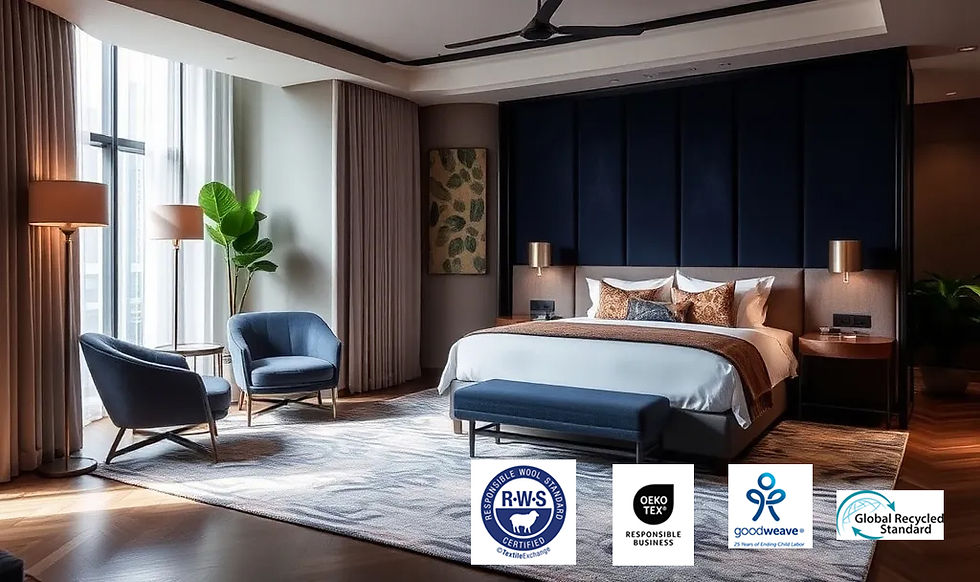
Today’s global buyers want more than beauty — they demand transparency and ethical craftsmanship.Export-quality rugs from India often come with certifications that verify responsible production:
GoodWeave Certification: Ensures rugs are child-labor-free and produced under fair labor conditions.
Fair Trade Certification: Guarantees artisans receive fair wages and work in safe conditions.
Woolmark License (for Hand-Knotted Rugs): Assures the wool used meets global quality and sustainability standards.
RWS (Responsible Wool Standard): Tracks wool from farm to finished rug to ensure humane animal treatment and environmental care.
By choosing certified carpets, international buyers support ethical rug manufacturing while getting a product of unmatched quality.
5. Testing and Quality Control
Before export, each rug undergoes stringent quality control checks:
Color Fastness: Ensures dyes don’t bleed or fade over time.
Pile Density & Strength: Tests confirm resilience under foot traffic.
Dimensional Stability: Ensures rugs retain shape after cleaning or long-term use.
Finishing Inspection: Edges, backing, and fringes are meticulously examined.
Many certified carpet exporters in India also employ CEPC (Carpet Export Promotion Council) guidelines to maintain uniform export standards. These checks guarantee that every piece shipped from India upholds the nation’s global reputation for rug excellence.
6. Innovation Meets Tradition
Modern luxury rug manufacturers in India are blending age-old techniques with cutting-edge technology. Using CAD design systems, weavers can reproduce intricate tribal patterns, geometric motifs, and abstract textures with remarkable precision.
Some companies also specialize in custom rug production, allowing interior designers and hotel project planners to specify size, color, and pattern — ensuring every rug fits its intended space perfectly.This flexibility, combined with factory-direct sourcing, positions India as a global hub for B2B carpet sourcing and private label rug production.
7. Sustainability and Global Demand
In the era of climate-conscious living, eco-friendly rugs and organic fiber rugs are more than trends — they are a necessity. Many Indian rug exporters are investing in sustainable dyeing processes, solar-powered workshops, and biodegradable materials to reduce carbon footprints.
From wool blend rugs to recycled fabric rugs, the shift toward sustainability enhances India’s image as a responsible and forward-thinking exporter. Buyers across Europe, the U.S., and the Middle East now associate Indian rugs not only with art and culture but also with ethical and green production.
8. Why Export-Quality Rugs Are Worth It
When you buy an export-quality rug from India, you’re not just buying a floor covering — you’re investing in:
Longevity: Crafted to endure decades.
Ethics: Produced in fair-trade environments.
Sustainability: Made with renewable, biodegradable materials.
Authenticity: Each rug tells a story woven by skilled artisans.
Whether it’s a hand-knotted wool rug for your living room, a modern abstract area rug, or a vintage-inspired heirloom piece, the mark of “export quality” ensures both visual beauty and enduring value.
Conclusion
India’s rug industry — led by Bhadohi rug manufacturers, certified carpet exporters, and luxury rug producers — continues to set benchmarks for quality and craftsmanship worldwide. Every rug that earns the label “export quality” represents a harmonious blend of tradition, innovation, and integrity.
So, when you next buy rugs online in India, look for the ones that proudly carry certifications like GoodWeave, Woolmark, or Fair Trade. Behind those labels lies a commitment to excellence — one that turns every Indian handmade carpet into a masterpiece of art, ethics, and enduring warmth.
#IndianRugs #BhadohiRugs #HandmadeRugs #HandKnottedRugs #ArtisanRugs #LuxuryAreaRugs #WoolRugs #SilkRugs #ModernRugs #TraditionalRugs #VintageRugs #CustomRugs #DesignerRugs #RugStore #RugStoreIndia #RugsOnline #BuyRugsOnlineIndia #HomeDecorInspiration #InteriorDesignIdeas #LivingRoomDecor #BohoHomeDecor #ModernInterior #ScandinavianStyle #LuxuryInteriors #MinimalistHome #CozyHomeVibes #HomeStyling #HomeMakeover


Comments