What Makes a Rug Supplier Export-Ready?

The global marketplace for handmade rugs is vast and competitive. For a buyer in New York, London, or Dubai, the difference between a smooth, successful partnership and a logistical nightmare often comes down to one question: is your supplier truly export-ready? This is not simply about having a product to sell; it's about possessing the entire ecosystem—from certifications and quality control to logistics and compliance—that allows for seamless international trade.
At PiHue Creations, headquartered in the heart of India's carpet-weaving belt, we understand what it takes to be a trusted partner for global B2B clients. Here is a comprehensive look at the pillars that define an export-ready rug manufacturer.

The Foundation: Regulatory Compliance and Trade Credentials
Before a single knot is tied, an exporter must have their legal and regulatory house in order. This is the bedrock of international trade and the first sign of a serious, professional supplier.
1. The Import Export Code (IEC)This is the most fundamental requirement for any Indian business looking to export. Issued by the Directorate General of Foreign Trade (DGFT), the IEC is a mandatory 10-digit code that allows a company to engage in cross-border trade. Without it, goods cannot clear Indian customs for export.
2. Registration with the Carpet Export Promotion Council (CEPC)For carpet and rug manufacturers, membership with the CEPC is non-negotiable. The council, established by the Government of India, exists to "support, protect, maintain, increase and promote the export of hand-knotted carpets, woolen druggets and floor coverings". Exporters must obtain a Registration-cum-Membership Certificate (RCMC) from the CEPC, which confirms they are a legitimate manufacturer or exporter of handmade carpets. This registration is not just a formality; it unlocks access to trade fairs, government incentives, and a network of verified global buyers.
3. Additional CredentialsA truly export-ready supplier often holds other credentials that signal operational excellence. Membership in bodies like the Export Promotion Council for Handicrafts (EPCH), or certifications like ISO 9001:2015 for quality management systems, demonstrate a commitment to professional standards that large-scale B2B buyers demand.
The Language of Trust: Essential Certifications
Modern B2B buyers are not just looking for beautiful products; they are looking for guarantees of safety, ethics, and sustainability. Certifications are the objective proof that a manufacturer meets these global standards.
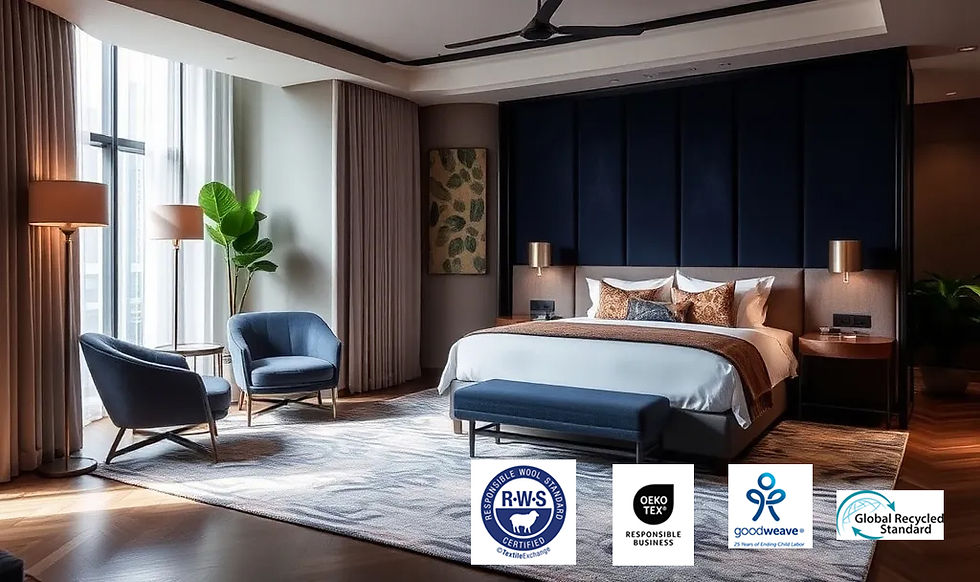
1. GoodWeave CertificationThis is arguably the most critical certification for the handmade carpet industry. GoodWeave provides the best assurance that a rug has been made without child, forced, or bonded labour. For ethically conscious brands, a GoodWeave-certified supplier is non-negotiable. It demonstrates a commitment to social responsibility that protects the buyer's brand reputation and aligns with global ESG goals.
2. OEKO-TEX® Standard 100For rugs destined for homes, hotels, or any indoor space, chemical safety is paramount. The OEKO-TEX® Standard 100 certification ensures that every component of a rug—from the yarn and dyes to the finishing agents—has been tested for over 350 harmful substances. An OEKO-TEX® certified rug manufacturer makes carpets and rugs that are proven safe for human use, free from formaldehyde, lead, and other hazardous chemicals. This is a powerful selling point for health-conscious consumers and commercial projects.
3. Global Recycled Standard (GRS) & Responsible Wool Standard (RWS)Sustainability is no longer a niche trend; it is a mainstream expectation.
GRS verifies the recycled content of a product and tracks it through the supply chain, appealing to buyers focused on circular economies.
RWS guarantees that wool comes from farms practicing ethical animal welfare and sustainable land management.
An export-ready manufacturer will hold these certifications and be able to provide the accompanying transaction certificates to prove compliance. They are "not just badges—they represent our core" commitment to quality and ethics.
The Proof is in the Product: Quality Control and Material Integrity
An export-ready supplier must have rigorous quality control (QC) processes in place to ensure every rug that leaves the factory meets the buyer's specifications. This is particularly critical for handmade products where variation is natural but must be kept within acceptable parameters.
1. Raw Material InspectionQuality begins before the weaving starts. Reputable manufacturers inspect all incoming yarns, dyes, and raw materials for quality, colour consistency, and durability. This ensures that the foundation of the rug is sound.
2. In-Process ChecksDuring production, skilled supervisors monitor knot density (measured in knots per square inch, or KPSI) and pattern accuracy. For an artisan quality rug, this step is vital to ensure the design is being executed correctly.
3. Finished Product InspectionBefore a rug is rolled for shipping, it undergoes a final, detailed inspection. This includes checking for:
Colourfastness: Ensuring dyes do not bleed or fade.
Edge Binding Strength: Verifying the rug's borders are secure.
Backing Adhesion: Making sure the secondary backing is properly attached and will not delaminate.
Dimensional Accuracy: Confirming the rug is the correct size.
4. Physical SamplingFinally, a reliable carpet supplier will always provide physical samples before bulk production. This allows the buyer to test critical attributes like texture, colour, and overall quality, ensuring that the final product will match their expectations. This step is a cornerstone of building trust and avoiding costly mistakes.
The Final Mile: Logistics and Compliance
Being export-ready also means mastering the art of international logistics. This includes understanding proper packaging, accurate documentation, and customs compliance.
1. PackagingRugs must be packaged to survive long ocean or air journeys. Standard best practices include vacuum compression, plastic wrapping, corner protectors, and roll packing for area rugs. This protects the rug from moisture, dirt, and physical damage during transit.
2. DocumentationAn export-ready supplier handles all necessary paperwork with accuracy and efficiency. This includes the commercial invoice, packing list, bill of lading or airway bill, and the certificate of origin. Accurate documentation is essential for smooth customs clearance in the destination country.
3. Customs and ComplianceA seasoned exporter is well-versed in the HS codes for carpets and rugs (such as HS Code 5701 for knotted carpets) and understands the specific regulatory requirements for major markets like the EU (REACH compliance) and the USA (CPSC regulations). This knowledge prevents costly delays and penalties.
The PiHue Advantage
At PiHue, we embody all these qualities. As a carpet and rug manufacturer from Bhadohi, we are rooted in a region that produces over 70% of India's export-grade hand-knotted carpets. Our commitment to quality is backed by certifications including OEKO-TEX, GoodWeave, ISO 9001, and GRS. We have the systems, the credentials, and the experience to be a partner you can trust.
Choosing an export-ready supplier is not just about finding a product; it's about finding a partner who can navigate the complexities of global trade, so you don't have to. It is the difference between a transaction and a relationship built on trust and reliability.