


Flatweave Fundamentals: Understanding Kilims, Dhurries, and More

Not all rugs have a thick, fluffy pile. In fact, some of the world’s most enduring and versatile floor coverings are created without a single knot or tuft. These are flatweaves—textiles woven on a loom where the warp and weft threads interlock to form a single, flat layer. They are lightweight, reversible, and often more sustainable than their piled counterparts.
Below we explore the core techniques and traditions, from the geometric symbolism of Anatolia to the everyday warmth of India.
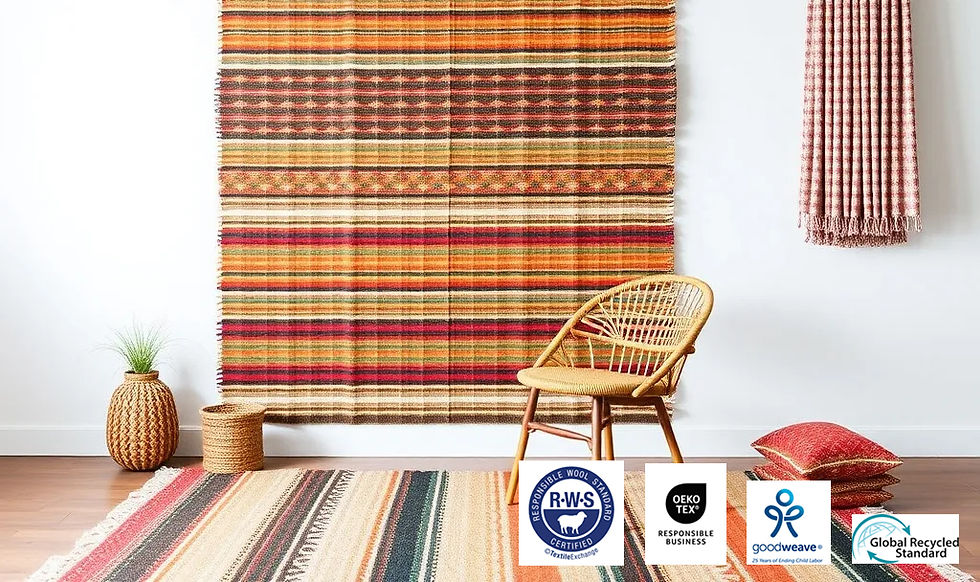
What Makes a Rug a Flatweave?
Unlike flatweave rugs, which have no pile, most people imagine carpets with a cut or looped surface. Flatweaves are produced by passing weft yarns horizontally through vertical warp threads, then beating them tightly together. The result is a thin, firm textile with distinct patterns on both sides—often mirror images or complementary designs.
Because there is no pile to crush, flatweaves resist matting and are easy to clean. They are ideal for high‑traffic areas, under dining tables, or in homes with pets. Their lightweight nature also makes them easy to roll, store, or transport.
Kilim Rugs: The Anatolian Storyteller
The term kilim rugs refers to a specific flatweave tradition originating from Central Asia, Anatolia, Persia, and the Balkans. Kilims are produced using a slit‑weave technique: when the weaver changes colour, a vertical gap or “slit” appears between adjacent colour blocks. These slits create sharp, angular patterns—often tribal motifs, geometric medallions, and stylised animal forms.
Historically, each motif in a kilim carried symbolic meaning. A diamond shape might represent fertility or protection; a hooked cross (or “Bukhara” symbol) warded off the evil eye. Today, kilims remain popular for their rustic charm, vibrant colours, and cultural authenticity. They are equally at home in a bohemian living room or a modern minimalist office.
Dhurries: India’s Everyday Flatweave
Where kilims are bold and symbolic, Dhurries are often softer and more subtle. The word “dhurrie” comes from the Sanskrit “dhur,” meaning “to be firm.” These flatwoven textiles have been produced in India for centuries, primarily from cotton, wool, or a blend of both.
Dhurries are typically made using a weft‑facing technique, where the horizontal weft threads completely cover the vertical warp. This produces a smooth, slightly textured surface that feels comfortable under bare feet. Traditional Indian dhurries feature striped, checkered, or floral patterns in earthy tones. They are reversible, washable, and surprisingly durable. In villages across Rajasthan and Uttar Pradesh, dhurries serve as floor coverings, bedspreads, and even wall hangings.
Flatweaves vs. Hand‑Knotted: A Key Distinction
It is important to distinguish flatwoven textiles from their piled cousins. Handmade rugs includes both categories, but the construction differs fundamentally. In hand-knotted rugs, individual knots are tied around warp threads, creating a dense pile that stands upright. This process is slow, labour‑intensive, and produces a thicker, plusher carpet.
Flatweaves, by contrast, involve no knotting. They are woven in a single continuous action, making them faster and more economical to produce. However, they lack the insulation and cushioning of a piled rug. For buyers seeking heirloom durability, knotted pieces are superior. For affordability, portability, and easy maintenance, flatweaves are an excellent choice.
Natural Fibre Extensions: Jute and Abaca
In recent years, flatweave techniques have been applied to a range of plant‑based materials. Jute rugs are a popular example. Jute is a long, soft, shiny vegetable fibre harvested from the jute plant, primarily grown in India and Bangladesh. When woven into a flatweave, jute creates a coarse, earthy texture that suits coastal, farmhouse, or bohemian interiors. Jute is biodegradable, renewable, and surprisingly strong, though it sheds initially and should not be placed in damp areas.
A more exotic option is abaca rugs. Abaca comes from the leaf stalks of a banana plant native to the Philippines, but it is now cultivated in several tropical regions. The fibre is exceptionally strong—twice as strong as jute—resists saltwater damage, and has a silky, golden appearance. Abaca flatweaves are rarer and often more expensive, prized for their lustre and durability in high‑humidity environments.
The Role of Flat Woven Rugs in Contemporary Design
The category of flat woven rugs encompasses all these techniques and materials. Their thin profile makes them ideal for layering—placing a smaller flatweave over a larger sisal or wool carpet adds colour and texture without bulk. They also work well under furniture that requires a smooth, stable base, such as dining chairs or office casters.
In commercial settings, flatweaves are valued for their low maintenance. Hotels use them on balconies and patios because they dry quickly after rain. Offices specify them in break areas where spills are common. And because flatweaves are reversible, a stained side can simply be flipped over, doubling the usable life.
Sourcing from India’s Weaving Heartland
India remains one of the world’s largest producers of flatwoven textiles, including dhurries and contemporary flatweaves. A reputable rug manufacturer from India will offer a wide range of constructions, materials, and custom options. Among the most respected are those based in the carpet belt around Varanasi, Mirzapur, and Bhadohi.
Bhadohi rugs are traditionally associated with hand‑knotted piled carpets, but the region’s workshops also produce exceptional flatweaves. Artisans there weave cotton dhurries with fine, even tension, creating patterns that remain crisp after years of use. Many Bhadohi manufacturers now offer custom flatweaves in any size, colour, or design—from simple stripes to intricate geometric repeats.
Embracing Natural Fiber Rugs
For environmentally conscious buyers, flatweaves made from plant fibres are a natural choice. Natural fiber rugs as a category includes jute, sisal, seagrass, coir, and abaca. All are renewable, biodegradable, and require minimal chemical processing.
When combined with flatweave construction, these materials produce floor coverings that are both beautiful and low‑impact. They do not require synthetic backing or heavy latex adhesives. They can be composted at the end of their life. And their subtle, organic aesthetic complements nearly any design style, from rustic to modern.
Final Thoughts: Choosing Your Flatweave
Before buying, consider the room’s traffic, moisture levels, and your tolerance for shedding. Wool and cotton flatweaves are soft and versatile. Jute and sisal offer durability but can feel rough. Abaca is a premium choice for humid spaces. And kilims bring pattern and heritage to any room.
Flatweaves have been woven for millennia, yet they feel entirely contemporary. Their honesty—no hidden pile, no glued backing—reflects a growing desire for simplicity and transparency in our homes. Whether you choose a striped Indian dhurrie, a tribal Anatolian kilim, or a plant‑based abaca rug, you are stepping onto a textile that connects you to centuries of craft. And that is a beautiful thing
1. What is the main difference between a flatweave rug and a hand‑knotted rug?
A flatweave rug has no pile. It is created by interlocking warp and weft threads on a loom, resulting in a thin, reversible textile. A hand‑knotted rug involves tying individual knots around warp threads to create a dense, upright pile. Flatweaves are lighter, more portable, and easier to clean, while hand‑knotted rugs are thicker, plusher, and generally more durable and expensive.
2. How can I tell a genuine kilim rug from a machine‑made imitation?
Authentic kilim rugs are hand‑woven using a slit‑weave technique, which creates small vertical gaps (slits) between colour blocks. They often feature slightly irregular, angular patterns and fringes that are an extension of the warp threads. Machine‑made imitations typically have perfectly uniform patterns, synthetic backing, and no slit‑weave structure. Examining the reverse side—genuine kilims show a mirror or complementary design, while fakes often have a blank or glued backing.
3. Are dhurries suitable for high‑traffic areas like hallways or dining rooms?
Yes. Dhurries are flatwoven and highly durable, especially those made from wool or cotton. Their low profile and tight weave resist crushing and matting, making them excellent for areas with heavy foot traffic, under dining tables, or in entryways. They are also easy to clean; most cotton dhurries can be machine‑washed on a gentle cycle. However, avoid using them on stairs without a non‑slip pad, as their thinness can be slippery.
4. What are the pros and cons of jute and abaca flatweave rugs?
Jute rugs are affordable, biodegradable, and offer a soft, earthy texture. They are best for low‑traffic, dry areas like bedrooms or studies. Cons: they shed initially, are not moisture‑resistant, and can develop mould in humid conditions. Abaca rugs are twice as strong as jute, resist saltwater and humidity, and have a silky, golden sheen. Pros: durable, suitable for sunrooms or covered patios, and long‑lasting. Cons: more expensive and less widely available.
5. Can I order custom flatweave rugs from Indian manufacturers?
Absolutely. Many rug manufacturers from India, particularly those in Bhadohi and Jaipur, offer custom flatweave rugs in any size, colour palette, and pattern. You can specify materials (cotton, wool, jute, abaca), design repeats, and even incorporate brand colours or logos. Request a sample strike‑off before full production to verify colour and weave quality. Lead times for custom flatweaves are typically shorter than for hand‑knotted rugs—often 4–8 weeks.


Comments