


How We Champion Traceable Wool & Support Himalayan Farming Communities

In the thin, crisp air of the Himalayan highlands, a shepherd watches over his flock. The rhythm of his life is dictated by the seasons and the migrations of his sheep across pasturelands that have sustained his community for centuries. This is where a rug's journey truly begins—not on a loom in Bhadohi, but on the rugged slopes of the world's highest mountain range. For PiHue, the story of a wool rug is inseparable from the story of the people and animals that produce its most essential ingredient.

The Source of Excellence
The finest wool comes from sheep that are healthy, well-nourished, and stress-free. This is not just an ethical principle; it is a practical one. Sheep raised in harsh conditions produce wool that is brittle, uneven, and prone to breaking. By contrast, sheep that graze freely on the clean, mineral-rich grasses of the Himalayas grow fleeces that are long, strong, and lustrous—the foundation of a rug that will last for generations.
Our wool sourcing is anchored in the Himalayan state of Himachal Pradesh, a region renowned for its high-altitude pastures and centuries-old pastoral traditions. Here, more than 520 farming families manage approximately 247,600 sheep across 29,000+ hectares of rotationally grazed grassland. The wool from these flocks is not a commodity to be traded at the lowest price; it is the product of a carefully managed ecosystem and a way of life that has survived for millennia.
A Standard of Care
To ensure that this heritage is preserved and that the animals are treated with the respect they deserve, PiHue sources its wool exclusively from farms certified under the Responsible Wool Standard (RWS). This international certification is the gold standard for ethical wool production, independently verifying progressive land management practices and the Five Freedoms of Animal Welfare.
The RWS is not a vague promise; it is a rigorous, third-party audited system. It ensures that:
Animal welfare is paramount: Sheep are treated humanely, with no harmful practices such as mulesing.
Land is managed sustainably: Himalayan pastures are protected from overgrazing, preserving them for future generations.
The supply chain is transparent: Wool is tracked from the farm to the final product, providing complete traceability.
By adhering to the RWS, PiHue guarantees that every New Zealand wool rug (or any wool rug we produce) is made from fibre that has been sourced with the highest regard for animal welfare and environmental stewardship. This is a commitment that our B2B partners can confidently communicate to their own clients.
Beyond the Fleece: Empowering Communities
The RWS also addresses the social dimension of wool production. It requires that farms meet strict criteria for worker safety, fair wages, and community engagement. This is where PiHue's commitment extends beyond the product to the people.
Our sourcing relationships support community development in some of India's most remote and vulnerable regions. By providing a stable, fair market for their wool, we help pastoralist communities maintain their traditional livelihoods in the face of modern economic pressures. This is not charity; it is a partnership. The shepherds of the Himalayas are not just suppliers; they are stewards of a landscape and a culture that are integral to the quality of our rugs.
A Full Spectrum of Assurance
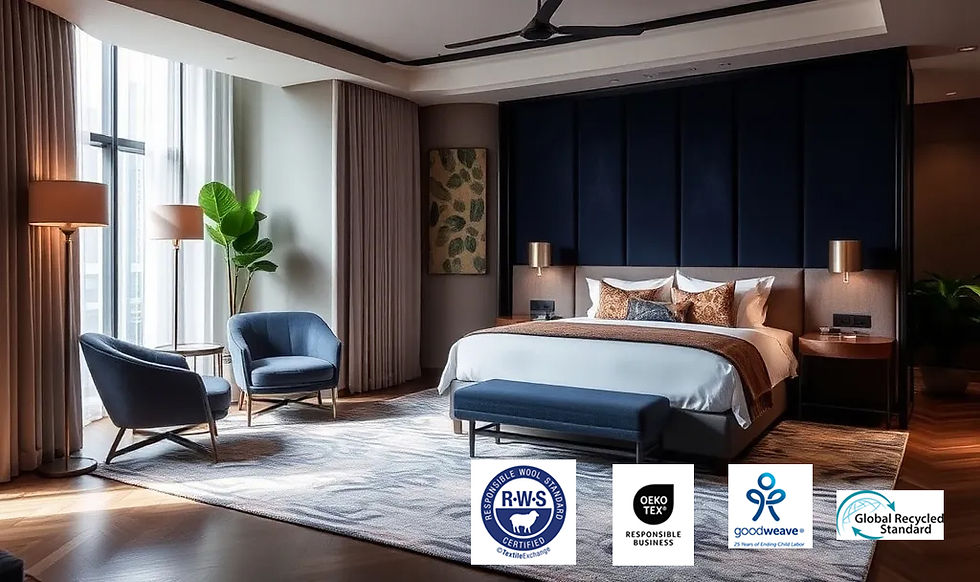
The RWS is one pillar of PiHue's commitment to ethical and sustainable production. We believe that a truly responsible rug must be safe for the people who make it, the people who use it, and the planet we all share. That is why our rugs carry a full spectrum of internationally recognised certifications.
GoodWeave Certification: This is the most powerful assurance that your rug was made without child, forced, or bonded labour. A portion of the price of every GoodWeave-certified rug supports the education of children in rug-making villages. PiHue is a proud GoodWeave licensee, ensuring that our supply chain is transparent and that the artisans who craft our rugs work in free, fair conditions. This certification is part of a global effort to combat child labour in textile communities.
OEKO-TEX® Certification: This globally recognised standard tests every component of a rug—from the wool fibres to the dyes and backing—for over 350 harmful substances. An Oeko Tex certified rug is proven safe for human use, making it ideal for hotels, healthcare facilities, and homes with children. It provides independent verification that our products are free from hazardous chemicals and safe for indoor air quality.
GRS and RWS Certification: The GRS RWS certified rugs label represents a dual commitment. The Global Recycled Standard (GRS) verifies recycled content and responsible processing, supporting a circular economy. The Responsible Wool Standard (RWS) provides the ethical wool assurance described above. Together, they demonstrate that a rug is both environmentally and socially responsible from start to finish.
The PiHue Difference
A custom wool rug from PiHue is not simply a floor covering; it is a story of sustainable stewardship. It is the story of a Himalayan shepherd, an artisan in Bhadohi, and a commitment to excellence that spans continents. As a wool rug manufacturer from Bhadohi, we are part of a 500-year-old weaving tradition, and we believe that tradition must be carried forward with integrity.
For our B2B partners, this traceability and commitment to ethical sourcing is a powerful advantage. In an era of increasing scrutiny and consumer demand for transparency, specifying a PiHue rug means you can confidently answer the question: "Where does your wool come from, and how do you know it was sourced ethically?"
We invite you to be part of this story. When you choose a PiHue Indian rug, you are not just investing in quality and beauty; you are investing in the welfare of animals, the preservation of traditional livelihoods, and the future of communities in the Himalayan highlands. That is a story worth telling, and a rug worth walking on.


Comments