


Rug Trends for 2026: What Bhadohi's Top Manufacturers Are Weaving Now

Updated: Jul 30
The global carpet and rug exhibition circuit—from Maison & Objet in Paris to Domotex in Germany and ICFF in New York—has spoken clearly. Handmade creations from India are leading the way. As we approach Bharat Tex 2026, the world's largest integrated textile fair scheduled for 14–17 July at Bharat Mandapam, New Delhi , the spotlight falls squarely on Bhadohi, India's official "Carpet City".
What are the region's most respected manufacturers weaving right now? Based on exhibition trends, buyer commissions, and workshop orders, here is what is actually selling in 2026.

The Quiet Palette Becomes the Loud Statement
For the better part of a decade, grey served as the safe default. By late 2024, that era ended. What designers now call the "quiet palette"—oat, sand, mushroom, soft clay, faded terracotta, and gentle sage—has become the room itself. Anything that reads cool-grey now appears dated within five years instead of fifteen.
Bhadohi's carpet manufacturer from India excels at producing pieces in these warm, earthy tones. Hand-knotted rugs featuring neutral beige, soft grey, cream, and warm sand tones dominate collections, paired with raw, undyed fibers and minimal geometric patterns. These premium quality floor coverings capture the balance of modern minimalism and organic warmth that buyers increasingly demand.
Interestingly, antique Oushaks and softly-washed Tabrizes were practically engineered for this palette a century before it had a name. The colours aged into exactly what designers now try to recreate in new production. Bhadohi's artisans have responded by developing vegetable-dye techniques that achieve similar patina without waiting fifty years.
Open Fields Replace Busy Borders
Traditional medallion-and-border layouts are receiving far fewer requests. Instead, designers commission "open field" designs—creations with breathing room, soft motifs, and either no border at all or a very minimal one.
The reason is functional, not merely aesthetic. Open furniture layouts—curved sofas, modular sectionals, asymmetric seating—become visually crowded fast under a busy border. Open-field designs let the area rug anchor and warm the space without competing with furniture or architecture.
B2B rug manufacturers in Bhadohi have adapted swiftly. Their hand-tufted carpets now feature allover patterns with generous negative space, allowing the texture and material quality to shine rather than relying on dense ornamentation.
Texture Takes Centre Stage
High-low piles, sculpted surfaces, and layered weaves are trending strongly. Handmade rugs from India excel at delivering this tactile richness—something machine-made alternatives struggle to replicate.
Abaca rugs have emerged as a standout category. These sustainable floor coverings offer a grounded elegance that enhances both ethnic and contemporary interiors. Jute provides an affordable, casual organic texture. Sisal and hemp options deliver firmer surfaces ideal for high-traffic zones.
Custom rug suppliers now offer blended constructions combining these natural fibres with wool, creating pieces that satisfy both sustainability commitments and design aspirations.
Colour Reform Maintains Momentum
The overdyed vintage category continues its strong run. These are antique or vintage Persian and Turkish pieces stripped of original colour and overdyed in a single saturated tone: deep teal, faded brick, soft indigo, pomegranate, ochre.
For many buyers, these represent the entry point into hand-knotted craftsmanship. They look modern enough for a contemporary room but feel like real rugs underfoot—because they are real rugs underfoot, 30–80 years old with all the structural integrity that implies.
Bhadohi manufacturers have introduced their own "color reform" lines, using traditional techniques to achieve similar effects on newly woven foundations. These luxury wool carpets appeal to designers seeking the vintage aesthetic without the procurement challenges of sourcing genuine antiques.
Sustainability as the New Baseline
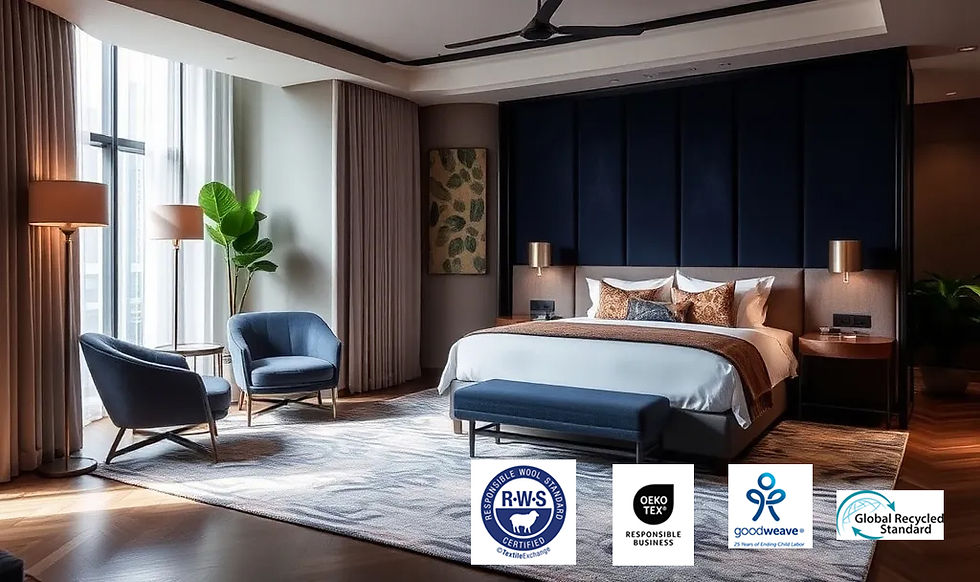
Sustainability is no longer optional. Buyers increasingly request certified OEKO-TEX and GRS RWS compliant creations made using eco-conscious processes.
Indian rug manufacturers are well-positioned here due to their reliance on natural fibres and traditional dyeing techniques. The Bhadohi-Mirzapur corridor alone accounts for an estimated 70–75% of domestic handmade output. This concentration of skilled artisans enables consistent quality across bulk orders while maintaining ethical production standards.
Bharat Tex 2026 will feature dedicated Sustainability and Recycling Pavilions spotlighting regenerative raw materials, circular fibres, low-impact processing, and traceable supply chains. For B2B rug manufacturers, this presents an unparalleled opportunity to verify supplier credentials firsthand.
Modern Meets Traditional
A key trend across global exhibitions is the fusion of traditional motifs with contemporary sensibilities. Indian exporters skillfully reinterpret heritage patterns—Persian, tribal, or geometric—into modern colourways.
The grandmillennial aesthetic celebrates this revival. Traditional motifs such as florals, medallions, and intricate Persian-inspired patterns appear with softer, updated palettes—dusty rose, powder blue, moss green, and ivory. Younger homeowners increasingly seek this timeless elegance.
Bhadohi's top manufacturers now offer collections spanning this entire spectrum: from antique Oushak interpretations to ultra-contemporary abstractions. This versatility has strengthened India's position as a preferred destination for premium residential and hospitality projects worldwide.
What This Means for Buyers
For procurement professionals, interior designers, and hospitality specifiers, these trends translate into clear action items:
Specify warm, earthy palettes over cool greys
Prioritize open-field designs that accommodate flexible furniture layouts
Request high-low textures and natural fibre blends for tactile interest
Verify sustainability certifications including OEKO-TEX, GRS, and RWS
Explore custom solutions that blend traditional motifs with contemporary colours
Bharat Tex 2026 at Bharat Mandapam offers the ideal setting to explore these trends firsthand. The Floor Coverings Zone will bring together hundreds of specialised manufacturers from across India's carpet belt, covering every construction type and price point. Heritage hand-knotted regions, luxury wool pavilions, natural fibre sections, and high-volume contract carpeting suppliers will all be represented.
Whether you seek heirloom-quality hand-knotted wool for a presidential suite or sustainable jute and sisal fibre for an eco-resort, Bhadohi's manufacturers are weaving exactly what 2026 demands. The quiet palette has arrived. Open fields have won. Texture and sustainability define the new standard. And India's Carpet City is leading the way.
Connect with verified Bhadohi rug manufacturers at Bharat Tex 2026. Book your meetings and discover premium handmade floor coverings backed by global certifications.
Working with a certified carpet manufacturer in India ensures quality, ethics, and reliable delivery for every project.


Beautiful rug trends! Fine woven patterns can be tricky in photos, so an online moiré remover can be really useful.